Gym Laundry Equipment: Sizing, Odor Control, and Cost
Table of Contents
Gym laundry equipment decides whether members get a fresh towel or a sour one. The washer runs nonstop during the morning rush. Meanwhile, towels pile up damp in a bin, and the smell sets before they reach the dryer.
That smell is a solvable problem, and the fix is mostly equipment and timing. Real Clean Group designs small business laundry rooms for gyms, sports facilities, and fitness studios across Colorado and Wyoming. The right setup keeps towels clean, keeps members happy, and costs less to run than most owners expect.
TL;DR: Gym Laundry Equipment
Gym towels smell because of body oil, damp storage, and slow drying, and more detergent rarely fixes it. Published research traces laundry odor to a bacterium that survives drying, and to skin oils that cool, short cycles fail to remove. The answer is a washer with enough capacity and extraction to clean fully, and a dryer sized to finish every load completely, right away. Size the room around your two daily peaks rather than your average, and the backlog that causes odor disappears. With the right machines, fresh towels become routine.
Key Points
Odor starts in the bin: Damp towels left waiting give bacteria a head start.
Body oil is the real soil: Skin oil is what cool, quick cycles leave behind.
Drying is not optional: CDC guidance says to dry towels completely in a dryer, not on a rack.
Peaks set the size: The morning and after-work rushes decide capacity, not your daily average.
The dryer is the bottleneck: An undersized dryer turns a fast washer into a slow laundry room.
Altitude changes the install: Commercial gas dryers need orifice changes at Colorado elevations.
Real Clean Group sizes gym laundry rooms at no cost. Request your free ROI report and we will size yours against your real towel volume.
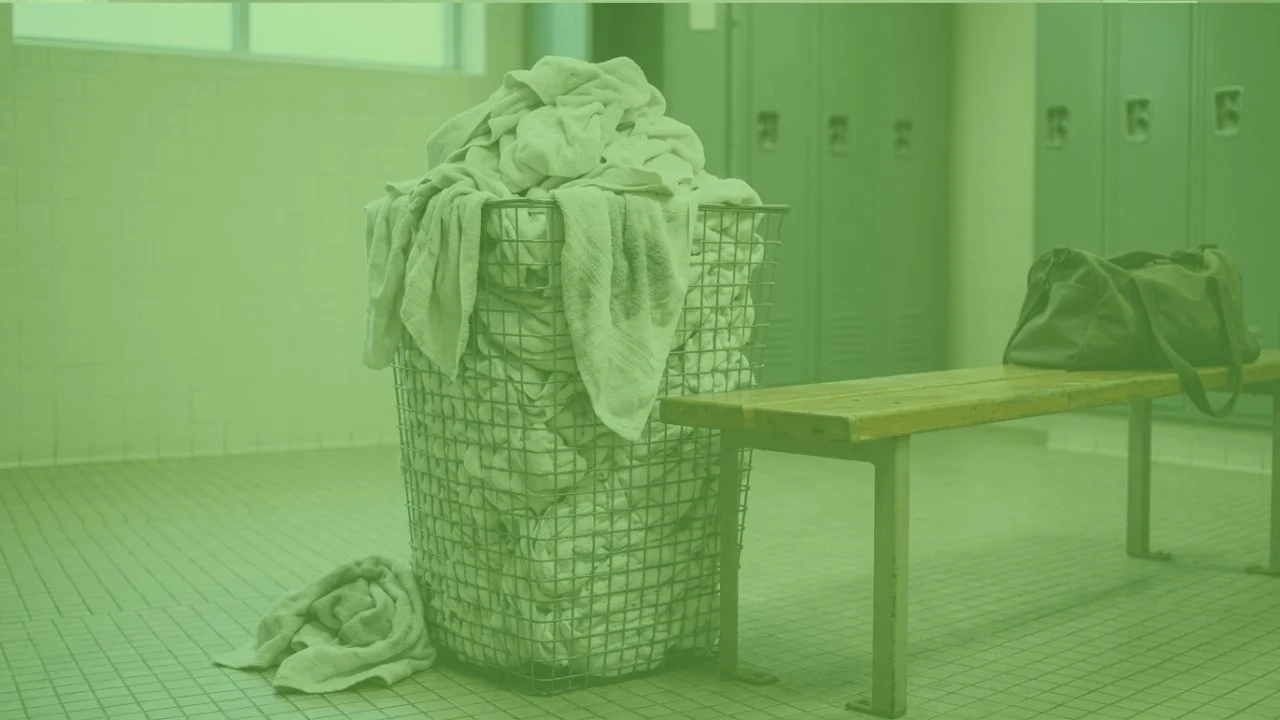
Why Gym Towels Smell Even After Washing
That sour, damp-cloth smell is not a mystery. Researchers have identified where it comes from, and the answer explains why a second wash often comes out smelling the same.
The main culprit is a bacterium. A 2012 study in Applied and Environmental Microbiology identified Moraxella osloensis as the primary source of malodor in laundry. The researchers found it common in laundry and household settings, and found that it tolerates drying. As a result, drying alone will not reliably kill it, which puts the burden on a thorough wash.
Body oil feeds the problem. A 2020 review in the journal Microorganisms found that "human sebum is the major constituent of the organic soil load on textiles." The same review reported that frequent low-temperature washing, especially without oxygen bleach, was inefficient at removing microorganisms, sebum, and odor compounds. It also found that slow drying left a higher microbial load on fabric, while fast tumble drying reduced it.
The review flagged two more factors worth knowing. Biofilm builds up in the damp, hard-to-reach parts of a washer, such as door seals, detergent drawers, and filters. In addition, washed polyester held more odor than washed cotton. Therefore, both the machine and the towel itself shape how fresh a load comes out.
Put together, odor control is an equipment and workflow decision rather than a detergent decision.
What Gym Towel Laundry Has to Get Right
Gym towel laundry carries a responsibility beyond smell. Towels touch skin in a shared space, so the process has to hold up every single day.
The CDC is specific about this. Its guidance on MRSA prevention for athletes tells people not to share towels and to "wash and completely dry (in a dryer, not through air/hang drying) your uniform, towels, and clothing after each use." That last instruction matters for gym owners. A towel rack in a back room does not meet that standard, while a properly sized commercial dryer does.
Temperature is the next question, and the honest answer has two parts. CDC guidance for healthcare laundry notes that hot-water washing at 160°F for 25 minutes is commonly recommended, and that lower-temperature cycles depend on bleach to work. Gyms are not hospitals, so treat that as a useful benchmark rather than a rule. Still, it points the same direction as the odor research: weak, cool, rushed cycles leave too much behind.
Sorting is the third piece, and it costs nothing. Pool towels, hot yoga towels, and standard gym towels pick up different soil, so they wash better as separate loads on cycles suited to each. Mixed loads force one compromise program onto everything. Separate loads let each towel type get the cycle it actually needs.
A process built on full washing, complete drying, and simple sorting protects members and the towel budget alike.
Sizing Gym Laundry Equipment Around Peak Hours
Sizing gym laundry equipment is where most facilities go wrong. They size to an average day, and then the rush hours bury them.
Start by counting, not guessing. For one normal week, weigh the towels that go into the washer each day, and note when they arrive. Towel weight varies widely by size and fabric, so your own scale beats any published average. Many gyms see two clear surges, one before work and one after. Those windows, not the daily total, set the capacity you need.
Next, plan for the backlog those surges create. Towels that sit damp through a rush are exactly the towels that start to smell. Therefore, the target is a room that clears each peak within a couple of hours, rather than a room that catches up overnight. Leave real headroom, because an overpacked drum cleans poorly and wears out faster.
Huebsch's on-premises hardmount washer-extractors come in 20, 30, 40, 60, and 80 pound capacities, and Huebsch states its 200 G-force extraction speeds "reduce drying time and utility consumption." That extraction figure matters for gyms in particular. Towels hold a lot of water, so every bit pulled out mechanically shortens the dry cycle, and the dry cycle is usually the bottleneck. Our guide on choosing the best equipment for your laundry business covers how capacity and extraction trade off.
Size the dryer to the washer, size both to your peaks, and towels stop waiting damp.
Fitness Center Laundry Equipment Features That Prevent Odor
Not every commercial washer handles gym towels equally well. Three features do most of the work against odor.
Programmable cycles. The odor research points to longer, more thorough washing rather than quick cool rinses. Fitness center laundry equipment with programmable controls lets you set the right cycle once and lock it in, so the 5 a.m. shift and the 9 p.m. shift run the exact same program. Consequently, results stop depending on who happens to be on duty.
Automatic chemical injection. Skin oil needs the right chemistry, as the 2020 review showed. An automatic dosing system feeds detergent and oxygen bleach in measured amounts on every load. As a result, staff never guess at quantities, and towels never get a short dose during a busy hour.
Machine hygiene and workflow. Biofilm forms in damp door seals, detergent drawers, and filters, so a daily wipe and an open door between shifts keep the machine itself from seeding odor. Workflow matters as well. Keep a clean side and a soiled side in the room, so washed towels never touch the cart that carried dirty ones.
Choose features that make the right process automatic, and odor control stops relying on memory.
Odor is a workflow problem, not a detergent problem. Wash fully, dry completely and right away, and keep the machine itself clean.
Climbing Gyms, Hot Yoga Studios, and Pools Need Different Setups
Fitness facilities do not all launder the same towel. The mix you run changes the setup you need, and Colorado has a lot of variety.
Hot yoga studios. Towels come back soaked through after a single class, and many studios use synthetic mat towels for grip. That matters, because the 2020 textile review found washed polyester held more odor than washed cotton. Synthetic towels therefore need the full programmed cycle with oxygen bleach, a prompt trip to the dryer, and their own loads separate from cotton. A studio that lets mat towels sit overnight will fight odor no matter which detergent it buys.
Pools and recreation centers. Pool towels arrive dripping, so they carry far more water into the washer than a towel used at the squat rack. Extraction speed earns its keep here, because the wetter the load, the bigger the payoff from a high-extract washer. In addition, recreation centers often run pool and fitness towels through one room, so saved programs for each make separate loads effortless.
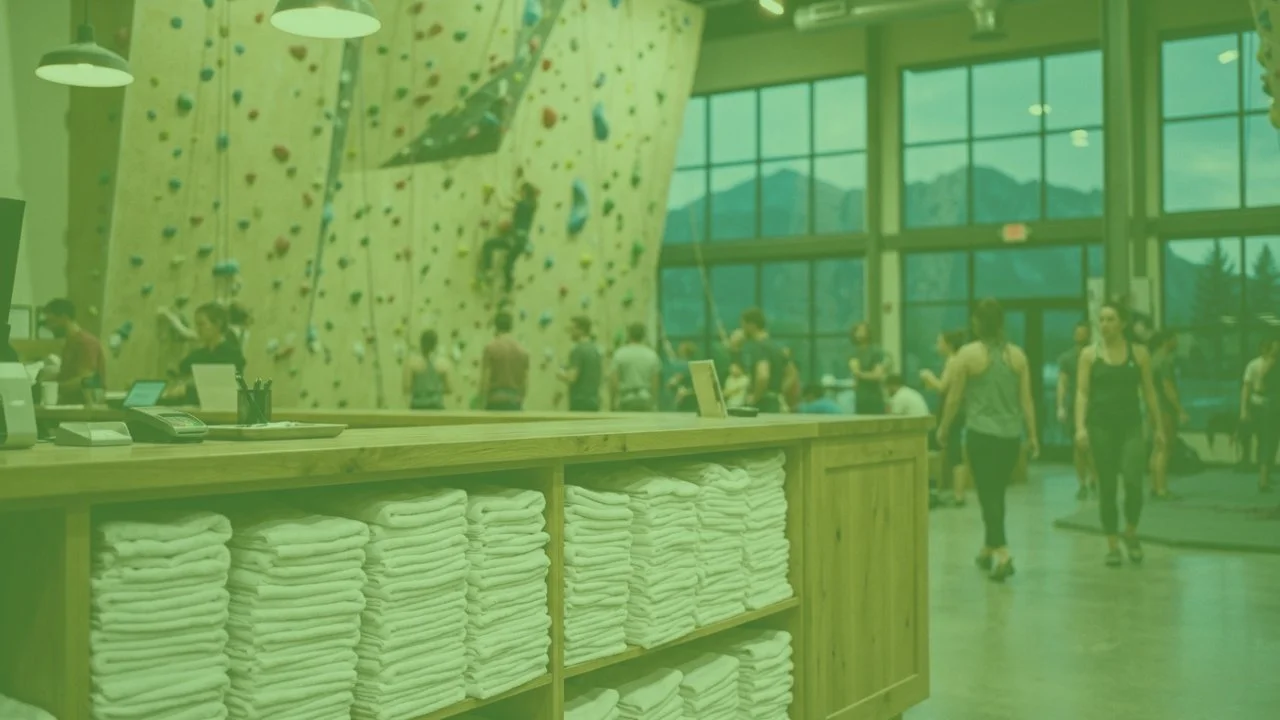
Small fitness rooms. Hotel fitness rooms, apartment gyms, and small boutique studios often run modest volume that folds into an existing housekeeping or staff routine. For them, one correctly sized washer and dryer pair is usually enough, and an oversized room wastes capital and floor space. Mixed-use climbing gyms sit in between, with towel demand that swings between quiet weekdays and packed weekend sessions.
Match the equipment to the towel mix you actually run, and each facility type gets a setup that fits rather than a generic one.
What Gym Laundry Costs to Run in Colorado
A towel service sends one invoice. Running laundry in-house spreads the cost across several lines, and you need all of them to compare fairly:
Installed cost: Machines plus delivery, plumbing, gas, venting, and electrical, not just the unit price.
Water and sewer: Your gallons per load times your rate, with sewer usually billed separately.
Gas and electricity: Drying dominates, which is why extraction speed moves this line most.
Labor: Staff minutes per load, including folding and restocking the front desk.
Chemistry: Detergent and oxygen bleach, priced per load rather than per drum.
Service and parts: A maintenance plan, or an honest repair budget if you skip one.
Then unpack the towel service invoice the same way. Most quote a per-towel or per-pound rate, and the real total also includes delivery charges, monthly minimums, and fees for towels that never come back. Add those up across a full year, not a single month, because rates and minimums rarely stay flat. Small rooms with modest volume sometimes do better staying outsourced, and an honest comparison will show that too. For busy gyms, however, the in-house lines often come in lower, and the comparison is how you find out.
Water deserves a closer look in Denver. Denver Water's 2026 business rates run $3.55 per 1,000 gallons at Tier 1, $6.07 at Tier 2, and $7.88 at Tier 3, with drought pricing built into the upper two tiers. A gym running laundry all day can climb tiers, so efficient machines save on volume and on rate. Denver Water also runs a custom commercial efficiency rebate of up to 50% of material costs, capped at $10,000 a year. Confirm eligibility with Denver Water before you buy, since projects over $2,500 need pre-approval.
Altitude adds an installation requirement that online orders miss. The installation manual for Alliance Laundry Systems' 50 and 75 pound tumble dryers states that above 2,000 feet, "the gas burner orifice size must be reduced to ensure complete combustion," and it specifies a heat input derate of 4% per 1,000 feet. Denver sits at 5,280 feet, and mountain-town rec centers sit far higher. Consequently, every gas dryer in this region needs altitude-correct setup by an authorized dealer.
Finally, budget for uptime rather than hoping for it. A gym that runs out of towels at 6 p.m. hears about it at the front desk. Real Clean Group backs installations with a 99% uptime guarantee and in-house service and maintenance. Total cost of ownership, measured against your current towel spend, is the number that decides this.
5 Signs Your Gym Has Outgrown Its Laundry Room
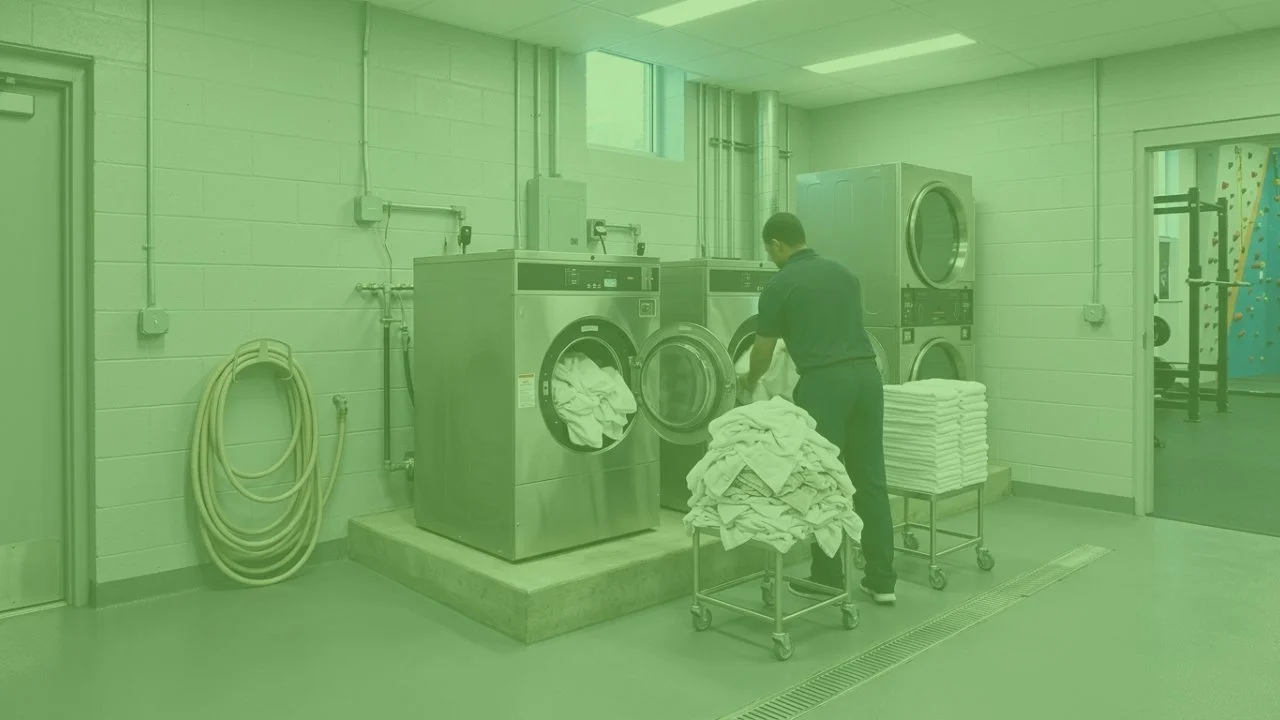
These signals come up again and again in the fitness facilities we assess across Colorado and Wyoming. Two or more usually means the room needs resizing.
Members mention the smell. By the time someone says it out loud, many more have noticed it quietly.
The return bin overflows during the rush. Towels waiting damp through a peak are where odor begins.
Towels come out of the dryer still damp. Long or repeated dry cycles point to low extraction, a restricted vent, or an undersized dryer.
The front desk runs out in the evening. Running short at peak means capacity sits below demand, even if the daily total looks fine.
Staff stay late to finish loads. A room that only catches up after closing is already too small for the facility it serves.
None of these call for the biggest machine on the market. They call for a proper sizing before the next complaint forces a rushed decision.
Conclusion
Gym laundry equipment works when it matches how your members actually use towels. Weigh a real week and note when the towels arrive. Size the washer and dryer together around your two daily peaks, with headroom built in. Then let programmable cycles, automatic chemistry, and high extraction handle the parts of odor control that staff should not have to remember. Fresh towels, every shift, become the default rather than the exception. Members notice the difference quickly, even when they never mention it.
Most gyms that fight towel odor do not have a detergent problem or a staff problem. They have a capacity and timing problem, and both are fixable with the right equipment and a clear plan. Real Clean Group handles equipment sales, service, parts, and renovation under one roof across Colorado and Wyoming, so the machines we recommend are the machines we then keep running. If uptime is your bigger worry, our guide to reducing machine downtime covers the habits that keep a busy laundry room moving.
Send us a week of towel counts and your current towel spend. Request your free ROI report and we will size the room to your peaks, then show you plainly what in-house laundry will cost to run.