Veterinary Clinic Laundry Equipment: Sizing and Cost Guide
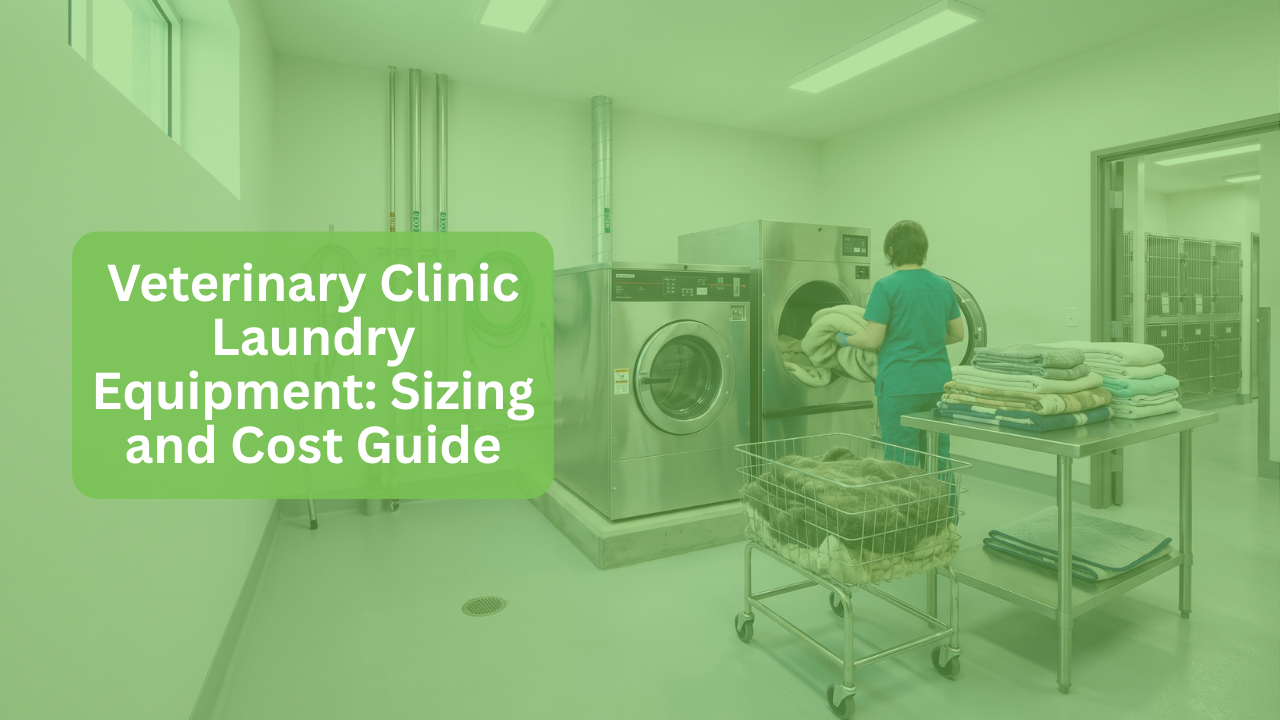
Table of Contents
Veterinary clinic laundry equipment gets specified last and breaks first. Most practices buy a residential pair, run it eight cycles a day, and replace it inside two years. Meanwhile the real costs pile up quietly: rewashes, downtime, and hair everywhere.
Vet laundry differs from other commercial laundry, and the difference is hair. Real Clean Group builds small business laundry systems across Colorado and Wyoming, and vet practices are the most demanding rooms we size. Getting the machine right once removes a headache for the life of the practice.
TL;DR: Veterinary Clinic Laundry Equipment
Vet clinics run a heavier, hairier, more contaminated load than almost any small business, and residential machines were never built for it. The decision comes down to three things: capacity sized to real daily poundage, extraction fast enough to cut dry time, and a lint routine that keeps hair from becoming a hazard. Published veterinary research also puts cycle length ahead of hot water for the pathogens clinics worry about. In short, an overpacked machine is the bigger risk, and sizing correctly costs less than owners expect.
Key Points
Hair is the defining variable: It loads lint screens, ducts, and drains far faster than fabric lint.
Overpacking beats temperature: Research on clinic textiles puts load space and cycle length ahead of water heat.
Residential machines fail on duty cycle: A home pair is built for a few loads weekly, not eight daily.
Extraction cuts your biggest energy line: Higher G-force pulls water out mechanically, so the dryer runs shorter.
Lint is a fire issue, not a chore: Federal data names failure to clean the leading contributing factor in dryer fires.
Altitude changes the install: Gas dryers above 3,000 feet need altitude-correct orifices. Every Colorado clinic clears that line.
Real Clean Group sizes veterinary laundry rooms at no cost. Request your free ROI report and we will size yours against real volume.
Why Residential Machines Fail in a Veterinary Clinic
The failure is not a quality problem. It is a duty cycle mismatch, and it shows up on a predictable timeline.
A residential washer is engineered around roughly eight loads per week. A busy small-animal practice runs that before lunch. Surgical drapes, exam towels, kennel bedding, warming blankets, and staff scrubs all cycle daily. Much of it arrives wet or heavily soiled. Consequently, bearings, suspension, and drain pumps see years of residential wear inside a single year of clinic use.
The second problem is what the laundry actually carries. The 2018 AAHA Infection Control, Prevention, and Biosecurity Guidelines are direct about it. Linens and professional garb, AAHA writes, "can serve as fomites, transporting pathogens within the practice and outside the practice into the community." The same guidelines call for facilities that can clean those items "daily or more frequently if necessary." A machine that cannot keep up forces staff to stretch intervals. Stretched intervals are how contamination travels.
Third, residential machines lack programmable cycles. The 2015 NASPHV Compendium of Veterinary Standard Precautions calls for separate storage and transport bins for clean and dirty laundry. It also directs that items be machine dried at the highest temperature the material allows. Those steps stay consistent only when the machine enforces them. Otherwise the protocol depends on whichever technician is nearest the washer at closing.
Pet Hair: The Variable Nobody Plans For
Every clinic knows hair is a nuisance. Very few plan equipment around it, and that gap is where the maintenance cost lives.
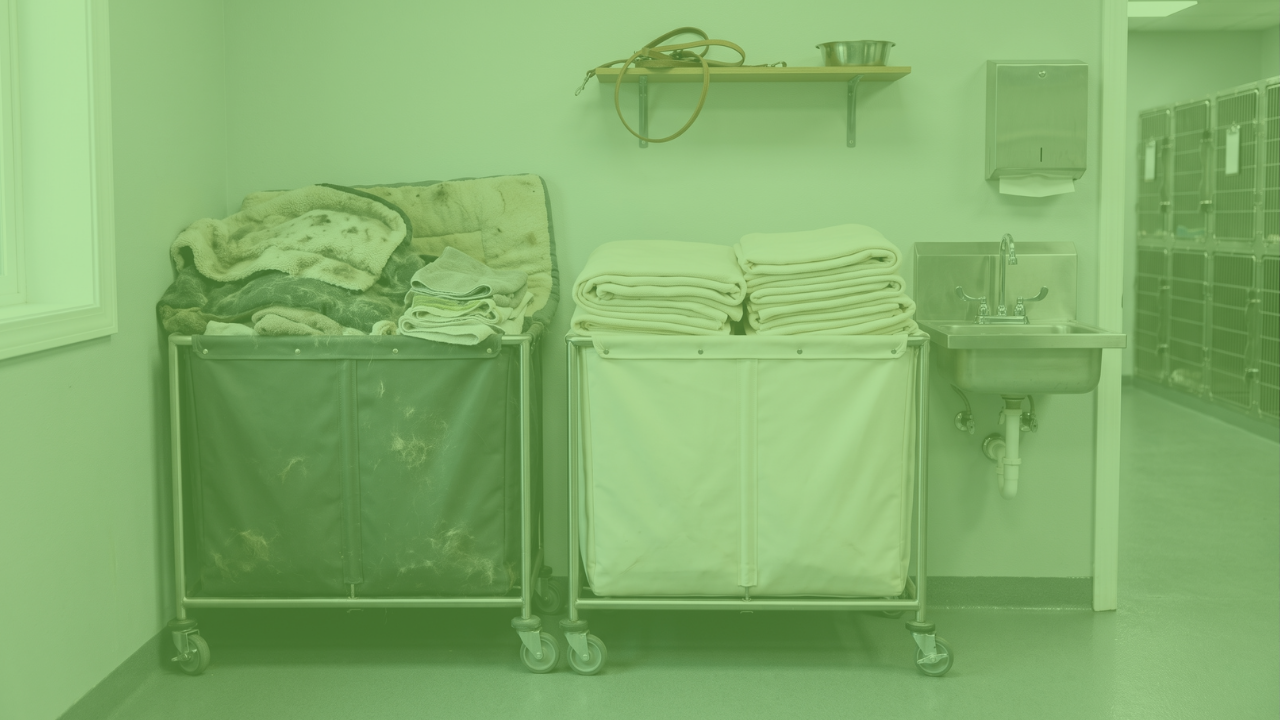
Hair behaves differently from fabric lint. It mats, it holds moisture, and it migrates past screens into ducting, burner housings, and drain lines. As a result, a dryer running clinic bedding restricts far faster than the same dryer running salon towels. Restricted airflow means longer dry times, which means more gas. The utility bill therefore climbs before anything visibly breaks. Hair travels downward too, collecting in drain lines and pump housings until drainage slows, which quietly stretches every cycle.
The safety side deserves plain language rather than alarm. The U.S. Fire Administration's report on clothes dryer fires covers 2008 through 2010. It found that "failure to clean (34 percent) was the leading factor contributing to the ignition of clothes dryer fires in residential buildings." That figure is residential, and no comparable veterinary dataset exists. However, the mechanism is identical. Clinics also generate more lint per load than any household.
Manufacturers publish the maintenance interval that answers this. Dexter's preventive maintenance schedule for single dryers sets three intervals. Clean the lint screen daily. Remove lint from the burner area monthly. Clear the exhaust system annually. Dexter states that failing to keep the burner area clean "can lead to a build-up of lint creating a fire hazard." In a clinic, treat the daily item as genuinely daily.
Equipment choice reduces the burden meaningfully. Larger lint collection surfaces and accessible service panels make the daily task fast enough that staff actually do it. Machines with front-facing screens beat machines that require moving a cart. When we assess an older clinic setup, drainage and screen access are the first two things we check. Above all, a routine that takes ninety seconds gets done, and one that takes fifteen minutes does not.
Sizing Veterinary Clinic Laundry Equipment to Real Volume
Sizing is the question every practice owner asks, and the one nobody in this category answers. Here is the method we use.
Start by weighing, not guessing. For one normal week, weigh each load before it goes in and total it by day. Most practices are surprised, because bedding is bulky but light while wet towels are the opposite. Your peak day, not your average day, sets the capacity you need. Then divide that peak by the cycles you can realistically run during business hours. A machine that needs after-hours babysitting will not get used that way.
Next, leave headroom deliberately. Peer-reviewed work on decontaminating clinic textiles is blunt: "the laundry tub should not be overfilled with clothing." Cycle length mattered more than water temperature. Therefore, sizing to exactly your peak poundage is sizing too small. Build in room, because an overpacked drum is both a cleaning failure and a mechanical one.
Huebsch's on-premises hardmount washer-extractors publish five capacities: 20, 30, 40, 60, and 80 pounds. All carry 200 G-force extraction, which Huebsch states "removes more water from each load, reducing energy costs and shortening drying times." That number matters more than it looks. Water pulled out mechanically never has to be evaporated with gas. A higher-extract washer therefore shortens every dry cycle for the life of the machine.
Finally, size the dryer to the washer rather than the other way around. Drying is the bottleneck in almost every clinic we assess. Pairing an undersized dryer with a correct washer just moves the queue. Our guide to choosing the best commercial washing machine covers the same tradeoffs in more depth. Size the pair together and the room runs itself.
Extraction is the quiet multiplier. Water pulled out mechanically at 200 G-force is water your dryer never has to evaporate with gas, on every load, for the life of the machine.
Veterinary Laundry Best Practices: Separation, Temperature, and Cycles
Veterinary laundry best practices come down to three controls. Two are free, and the third is where most clinics get the wrong advice.
Separation. Keep clean and soiled streams physically apart from the moment linen leaves the run. AAHA's 2018 guidelines set a specific isolation protocol. Items from infected animals get presoaked in diluted bleach, nine parts water to one part household bleach, for ten minutes. After that they are washed hot with bleach, then "completely dried in a separate load from any other laundry." Staff handling that stream wear gloves and a dedicated lab coat. Isolation laundry is a distinct workflow, not a hotter setting.
Temperature. Here the guidance splits, and the split is worth understanding. CDC guidance for healthcare laundry notes that "a temperature of at least 160°F (71°C) for a minimum of 25 minutes is commonly recommended." The same guidance confirms low-temperature cycles work when detergent and bleach are carefully controlled. That is human healthcare guidance applied by analogy, since vet-specific temperature standards are thin.
Cycles. For the pathogen clinics worry about most, the vet-specific evidence points somewhere else entirely. A 2015 study in the Journal of Feline Medicine and Surgery examined decontaminating laundry exposed to Microsporum canis, the ringworm organism. Cold and hot water performed equally well. Added bleach provided no measurable benefit against it. The authors concluded that "laundry can be effectively decontaminated by washing twice in cold water on a long wash cycle." Mechanical action, cycle length, and load space did the work.
Odor is worth a note, since it is the complaint clients actually notice. Persistent smell in clean linen usually signals loads sitting wet before drying, insufficient rinse for the soil level, or biofilm in a machine that never dries out. More fragrance solves none of them. Adequate capacity, a complete rinse, and prompt transfer to the dryer fix nearly all of it. The practical translation across all three controls is the same: specify programmable cycle lengths and enough capacity to avoid overpacking, then lock your protocols into the controls so they survive staff turnover. Equipment that makes the right procedure the easy procedure is the whole point.
What Animal Hospital Laundry Equipment Costs to Own in Colorado
Animal hospital laundry equipment carries a purchase price and an operating cost. The second decides whether the first was a good decision, so build the full picture before you compare quotes. Six lines belong in it:
Installed cost: Machine, delivery, rigging, plumbing, gas, venting, and electrical, not just the unit price.
Water and sewer: Gallons per pound times your rate, with sewer billed separately and often higher.
Gas and electricity: Drying dominates, which is why extraction speed changes this line the most.
Labor: Staff minutes per load, including the daily lint routine and folding.
Chemistry: Detergent and any disinfectant program, priced per pound rather than per jug.
Service and parts: A maintenance plan, or an honest repair budget if you skip one.
Water is the line most Colorado clinics underestimate. The EPA's 2023 WaterSense at Work guidance puts commercial washer-extractors at 2 to 4 gallons per pound of laundry. Efficient replacement models run under 2.5 gallons. Meanwhile, Denver Water's 2026 business rates run $3.55 per 1,000 gallons at Tier 1, $4.97 at Tier 2, and $5.68 at Tier 3. Drought surcharges add $1.10 and $2.20 to Tiers 2 and 3. A clinic pushed up a tier then pays more per gallon on everything, not just laundry.
That tiering is also why efficiency pays twice. A machine that uses less water per pound lowers the volume and helps keep the practice in a cheaper tier. Denver Water's custom commercial efficiency rebate covers up to 50% of material costs, capped at $10,000 annually. It requires pre-approval before purchase. Very few practices apply, largely because nobody tells them it exists.
Altitude adds a real installation requirement. Alliance Laundry Systems' dryer installation instructions are specific. Above 3,000 feet, the gas valve orifice must be reduced to ensure complete combustion, and Alliance publishes an orifice table by elevation. Denver sits at 5,280 feet, Colorado Springs at 6,035, and Cheyenne at 6,062. Consequently, every clinic here needs altitude-correct setup. That is one reason ordering a machine online tends to end in a service call.
Finally, budget for service rather than hoping. Real Clean Group backs installations with a 99% uptime guarantee and in-house service and maintenance. A clinic that cannot wash today does not get to postpone surgery. Total cost of ownership, not sticker price, is the number that decides this.
5 Signs Your Clinic Has Outgrown Its Laundry Setup
These signals show up repeatedly in the veterinary practices we assess across Colorado and Wyoming. Two or more usually means the room needs resizing.
Laundry runs after closing. If someone stays late to finish loads, your capacity is already short of your daily volume.
You clean the lint screen more than once a day. That is not a discipline problem. It is the machine telling you the hair load exceeds its design.
Bedding comes out still damp. Long or repeated dry cycles usually mean low extraction, a restricted vent, or an undersized dryer.
You have replaced a washer within three years. Residential duty cycles fail on schedule in a clinic, and the replacement will too.
Staff reuse blankets a little longer than protocol says. When the machine cannot keep up, protocols quietly bend, and that is the real risk.
None of these mean you need the largest machine available. They mean the room deserves a proper sizing before the next failure forces a rushed decision.
Conclusion
Veterinary clinic laundry equipment is not a complicated purchase once you measure instead of guess. Weigh a real week. Size to your peak day with headroom rather than to your average. Specify extraction high enough to shorten every dry cycle. Pair the dryer to the washer rather than buying them separately. Then build the daily lint routine into opening or closing, because that ninety-second habit protects the equipment and the practice.
The reason so many clinics end up on their third residential pair is not budget. It is that nobody sized the room for the real duty cycle, and hair makes that cycle harsher than almost any other small business. Real Clean Group handles equipment sales, service, parts, and renovation under one roof across Colorado and Wyoming. The machine we recommend is the machine we then have to keep running. If your practice is still weighing in-house at all, our breakdown of in-house laundry vs outsourcing covers that math first.
Send us a week of load weights and your utility bill. Request your free ROI report and we will size the room against your real numbers. We will specify the pair together, then tell you plainly what it costs to own.