The Monthly Cost to Run a Laundromat
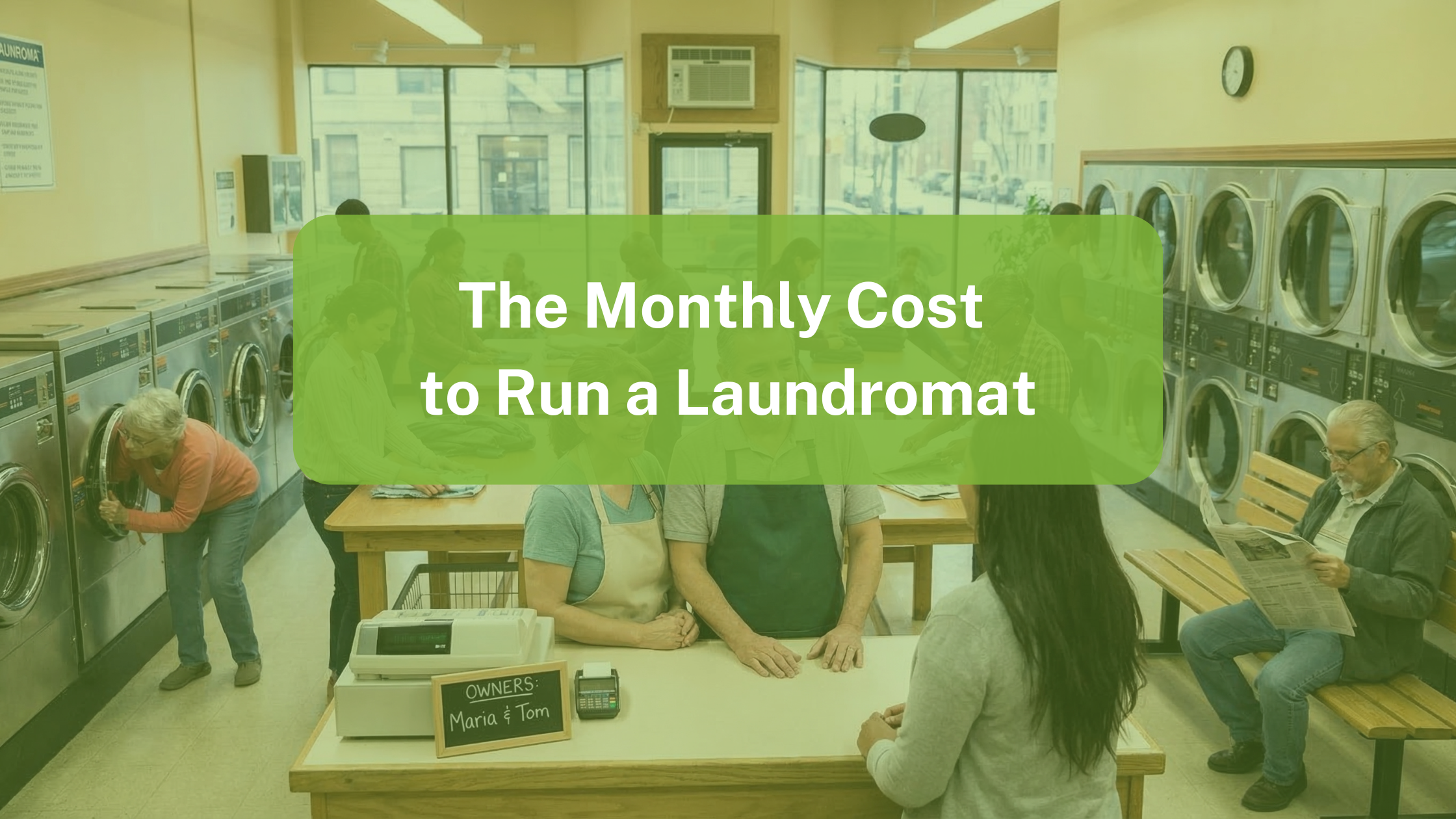
Table of Contents
Understanding the monthly cost to run a laundromat is what separates owners who build wealth from those who bleed cash. Behind the spinning machines and folding tables sits a web of recurring expenses - utilities, rent, maintenance, payroll, insurance, and supplies - that typically range from $5,000 to $17,800 per month depending on your store's size, location, and service model. At Real Clean Group, we help laundromat owners across Colorado and Wyoming keep their equipment running efficiently and their operating costs under control.
Whether you're tightening the numbers on an existing operation or mapping out your first business plan, this guide breaks down every major laundromat expense category with real dollar ranges. For a full look at startup investment, see our guide on the cost to open a laundromat. This article focuses on what happens after the doors open.
TL;DR:
Laundromat operating costs range from $4,000 to $8,500 on average, though larger or full-service stores can push well past $17,000 monthly. Utilities eat 15-40% of your budget, rent consumes about 9% of annual revenue, and maintenance should get 15-20% of your total operating spend. Despite these costs, well-managed laundromats report average net profit of $5,000 to $7,000 monthly with profit margins of 20-35%.
Key Points:
Total monthly operating costs: $5,000-$17,800 depending on size and model
Utilities: $1,500-$2,500+ (15-40% of total operating expenses)
Rent or mortgage: About 9% of annual revenue ($1,125-$3,750/month)
Maintenance and repairs: 15-20% of operating costs; service calls run $120-$500
Payroll: 25-35% of operating expenses if you staff the store
Insurance: $500-$1,500 annually ($42-$125/month)
Supplies: $150-$300/month (about 8% of revenue)
Average laundromat profits: $5,000-$7,000/month net with 20-35% margins
Want to lower your monthly costs with equipment that runs efficiently and lasts? Contact Real Clean Group for a free equipment assessment and ROI consultation.
““Knowing your numbers month to month isn’t optional - it’s what keeps the lights on and the machines spinning. The owners who track every dollar are the ones still in business five years from now.” ”

What Are the Total Monthly Costs to Run a Laundromat in 2026?
The total cost of running a laundromat lands between $5,000 and $17,800 per month for most operations. Where you fall in that range depends on your store's size, location, equipment age, and whether you run a self-service or full-service model. According to industry expense data, the expenses incurred while running a store range between 65% and 115% of gross income, which means tight cost management is the difference between profit and loss.
For a sole proprietorship laundromat, annual expenses can run around $19,889 (roughly $1,657/month), with about 8% of revenue going to materials and 5% to utilities. Larger operations with payroll, premium leases, and full-service offerings will land much higher. The key is understanding each expense category so you can control the ones within your reach.
Breaking Down Laundromat Monthly Operating Expenses
Every dollar you spend falls into a predictable set of categories. Here's what each one looks like in practice.
Rent or Mortgage Payments
Rent or mortgage is typically the highest fixed expense, consuming about 9% of annual revenue. For a laundromat generating $150,000-$500,000 in annual revenue, that translates to roughly $1,125-$3,750 per month. Triple net (NNN) leases are common in the industry, so budget for property taxes, building insurance, and common area maintenance on top of base rent. According to Lendio's startup cost guide, rent costs can range from $1,500 to $5,000 per month depending on your market.
The general rule: keep total occupancy costs at or below 20-25% of gross revenue. A high-rent location near apartments or transit hubs often generates enough extra traffic to justify the premium.
Utilities: Water, Electric, and Gas Costs
Utilities are where laundromat expenses hit hardest. Monthly utility costs range from $1,500 to $2,500 or more, often accounting for 15-40% of total operating expenses. A typical breakdown: water at about 12% of utility costs, electricity at 32%, and gas at 6%. SVP Funding Group's analysis provides detailed benchmarks on commercial laundromat electric bills that help owners gauge where they stand relative to industry norms.
In Colorado, water rates along the Front Range have been climbing year over year. Denver Water, Aurora Water, and Colorado Springs Utilities all use tiered commercial rates that penalize high usage. Investing in water-efficient machines directly protects your monthly margins.
Equipment Maintenance and Repairs
Allocate 15-20% of total operating costs to maintenance and repairs. Individual service calls typically cost $120-$500 depending on the issue. A broken machine doesn't just cost you the repair - it costs every dollar that machine would have earned while sitting idle. Owners who invest in preventive maintenance consistently spend less annually than those who wait for breakdowns. For more detail on managing equipment uptime, see our guide on reducing machine downtime.
Payroll and Labor Expenses
Employee salaries, if applicable, can represent 25-35% of operating expenses. A fully self-service laundromat with cashless payment can operate with a part-time attendant at $1,000-$2,000 per month. Full-service operations with wash-and-fold and delivery need more hands, pushing labor to $4,000-$8,000 monthly. Don't forget payroll taxes and workers' comp, which add 10-15% on top of gross wages.
Schedule staff during peak hours and let the store run unattended during slower periods. Remote monitoring cameras and connected machine alerts make this practical and safe.
Insurance Costs
Insurance premiums range from $500 to $1,500 annually, which breaks down to $42-$125 per month. That covers general liability and commercial property insurance. Business interruption insurance adds another layer of protection if a fire or major equipment failure forces you to close temporarily. Talk to a broker familiar with laundromat operations to make sure you're covered without overpaying.
Marketing and Advertising
Marketing costs range from $200 to $1,000 per month for Google Business profile management, local ads, signage, and social media. Marketing costs can represent 20-25% of gross revenue for newer stores trying to build a customer base, though established locations can spend much less. For ideas on where to put your marketing dollars, see our guide on the best laundromat marketing ideas.
Supplies and Cleaning Products
Supplies including detergents, softeners, and cleaning products range from $150 to $300 monthly, or about 8% of revenue. This also covers trash bags, paper towels, and restroom supplies. For a full breakdown of what to stock, see our guide on commercial laundry supplies your laundromat needs.
Payment Processing and Transaction Fees
Card and app-based payment processing typically costs $100-$400 per month. As more customers expect cashless options, this expense is becoming standard. The upside: cashless systems reduce theft, simplify accounting, and often increase average spend per customer since people tend to use more premium cycles when they're not counting quarters.
Fixed vs. Variable Monthly Costs in Laundromat Operations
Understanding which costs are fixed and which fluctuate with customer volume helps you forecast accurately and identify where you have leverage.
Fixed costs: Rent, insurance, loan payments, base payroll, and software subscriptions. These stay roughly the same regardless of how many loads you run.
Variable costs: Utilities, supplies, payment processing fees, and repair frequency. These rise and fall with customer volume and equipment condition.
Most profitable laundromats keep fixed costs to 30-40% of revenue and manage variable costs aggressively through efficient equipment and proactive maintenance. When variable costs spike unexpectedly, it usually points to an equipment problem - a leaking machine driving up water bills, or a dryer with clogged vents running longer cycles and burning more gas.

How Laundromat Size and Location Impact Monthly Expenses
Not every laundromat carries the same overhead. Size and geography create significant cost differences.
Small vs. Large Laundromat Cost Differences
A compact 10-15 machine operation in a strip mall might run $4,000-$8,000 per month in total expenses. A large 40+ machine store with wash-and-fold service can push past $15,000-$20,000 monthly. Larger stores generate more revenue but also carry higher utility bills, more maintenance needs, and often require dedicated staff. The sweet spot for many independent owners is a mid-sized store with 20-30 machines that balances revenue potential against manageable overhead.
Urban vs. Suburban Location Cost Variations
Urban laundromats in high-traffic areas pay premium rent but typically generate higher revenue per machine. Suburban locations offer lower rent and utility costs but may need stronger marketing to build customer volume. In Colorado, a Denver Capitol Hill location might cost $4,000-$6,000 in rent while a comparable space in Pueblo or Greeley runs $1,500-$2,500. The cheaper space only wins if it generates enough traffic to cover the gap.
Calculating Your Monthly Laundromat Operating Budget
Building a realistic monthly budget starts with tracking every dollar that flows out. Use a spreadsheet or laundromat management software to categorize expenses monthly. Compare your numbers against industry benchmarks to spot areas where you're overspending. Trycents' expense calculator is a useful starting tool for benchmarking your store against typical ranges.
Typical Expense-to-Revenue Ratios for Profitable Laundromats
Profitable laundromats generally keep total expenses to 65-75% of gross revenue. Here's what healthy ratios look like for a mid-sized Colorado operation:
Utilities: 15-25% of revenue
Rent/occupancy: 15-20% of revenue
Maintenance: 5-10% of revenue
Labor: 10-20% of revenue (or $0 if unattended)
Supplies, marketing, insurance, processing: 8-12% of revenue combined
Net profit margin: 20-35%
If your total expenses regularly exceed 80% of revenue, something needs to change - either your costs are too high or your pricing is too low. For detailed financial planning, Financial Models Lab's operating cost breakdown offers a structured framework for modeling laundromat finances.
Best Strategies to Reduce Monthly Laundromat Operating Costs
Cutting costs doesn't mean cutting corners. These are the strategies that consistently move the needle for laundromat owners.
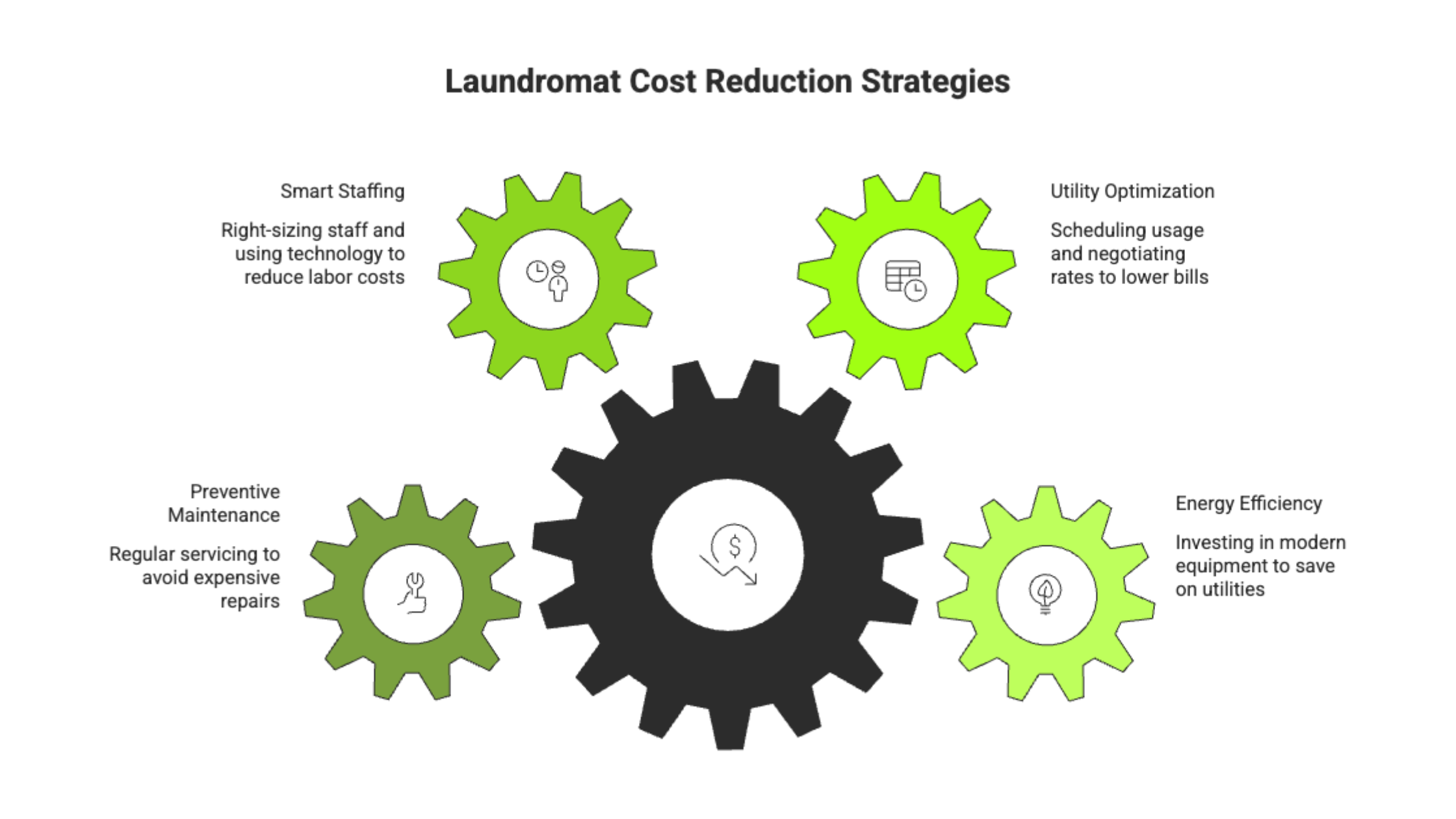
Investing in Energy-Efficient Equipment
Modern high-efficiency washers use 45% less water and consume significantly less energy per cycle. The savings compound every month and typically pay back the equipment investment within 2-3 years. If you can't replace your entire fleet at once, start with the oldest machines. Real Clean Group helps owners select the right commercial laundry equipment based on traffic patterns, space, and budget.
Optimizing Utility Usage and Negotiating Rates
Schedule your heaviest loads during off-peak hours if your utility offers time-of-use pricing. Upgrade to LED lighting for $1,500-$5,000 and recoup the cost in 12-18 months through lower electric bills. Ask your Colorado utility provider about commercial rate programs - Xcel Energy and Colorado Springs Utilities both offer options that reward efficient operations.
Smart Staffing and Labor Management
Right-size your staffing model to match actual customer patterns. Use remote monitoring and cashless payment to reduce the need for full-time on-site staff. Schedule attendants during peak windows and let the store operate unattended during slower periods. Even cutting 10 hours of weekly staffing at $15/hour saves $600+ per month.
Preventive Maintenance to Avoid Costly Repairs
Spending $200-$500 on a quarterly service visit prevents the $700-$1,500 emergency repairs that always hit at the worst time. Real Clean Group's maintenance programs include filter cleaning, belt adjustments, vent inspections, and priority emergency response. Tracking repair costs per machine also tells you when it's time to repair or replace rather than keep sinking money into aging units.
Monthly Costs vs. Profit Potential: Understanding Laundromat ROI
Despite significant monthly expenses, how much do laundromats make? The answer is encouraging. Well-managed laundromats report average net profit of $5,000 to $7,000 monthly, with laundromat profit margins landing between 20-35%. According to The Laundry Boss, a healthy laundromat often yields 20-35% annual ROI depending on scale, efficiency, and debt service.
How much does a laundromat make a month? A mid-sized store grossing $20,000-$30,000 with well-controlled expenses should net $4,000-$10,000 after all costs. The owners who hit the higher end share common traits: efficient equipment, disciplined maintenance, smart pricing, and lean operations. For more on the financial upside, see our guide on laundromat profit potential and our overview of investing in laundromats.
Common Hidden Monthly Expenses Laundromat Owners Overlook
Even experienced owners miss costs that quietly erode margins. Watch for these:
Water leaks from aging hoses and valves: A slow leak can add hundreds to your monthly water bill before you notice. Inspect connections quarterly.
Clogged dryer vents increasing gas costs: Restricted airflow forces dryers to run longer cycles, burning more gas and wearing out heating elements faster.
Payment processing rate creep: Processors quietly raise rates over time. Review your statements annually and renegotiate or switch if rates have climbed.
Deferred maintenance snowballing into emergencies: A $150 belt replacement ignored today becomes a $1,200 motor failure next month.
Unused software subscriptions: Management tools, marketing platforms, and POS systems you signed up for but stopped using. Audit your subscriptions quarterly.
The Nav small business resource guide offers additional insight on costs that new laundromat owners frequently underestimate.
Creating a Realistic Monthly Budget for Your Laundromat
Start by collecting three months of bank statements, utility bills, and repair invoices. Categorize every expense as fixed or variable, then compare against the benchmarks in this guide. Financial Models Lab's laundromat operating cost framework provides a structured model you can adapt to your own numbers.
Set a monthly review date. Fifteen minutes once a month reviewing your expenses against budget catches problems early - a water bill that jumped 30% probably means a leaking machine, not more customers. Build in a contingency of 5-10% of monthly revenue for unexpected repairs or equipment failures. Owners who reserve this buffer avoid the financial stress of emergency spending.
If you're building a budget for a new store, pair this expense guide with our ROI-focused equipment guide to see how equipment choices directly affect your monthly cost structure.

Conclusion
The monthly cost to run a laundromat is manageable when you know where every dollar goes. Utilities, rent, and maintenance make up the bulk of your overhead, and each one can be optimized with the right equipment, lease terms, and service programs. Owners who track expenses closely, invest in energy-efficient machines, and commit to preventive maintenance consistently run more profitable operations with stronger laundromat profit margins than those who don't.
Real Clean Group helps laundromat owners across Colorado and Wyoming keep their operations running at peak efficiency. From commercial laundry equipment built for high-volume use to service and maintenance programs that prevent costly breakdowns, we're the commercial laundry partner that understands your bottom line. Contact us today for a free consultation on how to lower your monthly costs and get more out of your equipment.
Thinking about upgrading your machines to cut utility costs? Start with our guide on top laundromat equipment to see what's available for your operation.