Table of Contents
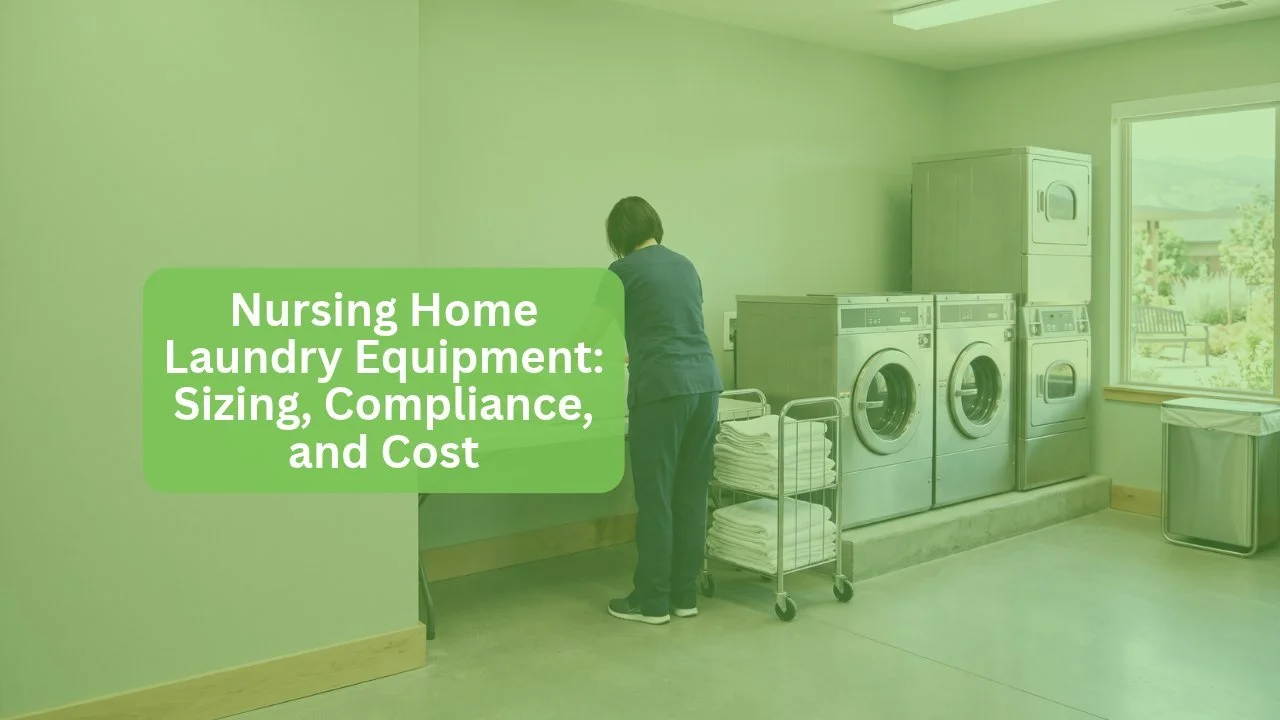
Nursing home laundry equipment runs every day of the year, and residents notice the moment it falls behind. A missing cardigan, a late linen change, or a scratchy blanket reaches families fast. Meanwhile, state surveyors expect a process that controls infection from the hamper to the closet.
Real Clean Group designs and services on-premise laundry for nursing homes, assisted living, and memory care communities across Colorado and Wyoming. The right room keeps residents comfortable, keeps surveys uneventful, and costs less to run than most operators expect.
TL;DR: Nursing Home Laundry Equipment
Senior care laundry works when the room matches the rules, the residents, and the real weekly volume. Colorado sets detailed capacity, airflow, and handling rules for nursing homes, and lighter but specific rules for assisted living. Build separate clean and soiled sides into the layout, as CDC guidance describes. Then size from pounds per bed per day, adjusted for run days, memory care, and personal clothing. Add dependable service, and laundry becomes the department nobody has to worry about.
Key Points
Colorado sets a capacity floor: Nursing homes need capacity for a seven-day supply at 10 pounds per bed per day.
Airflow is part of compliance: Soiled areas exhaust outside, and clean linen rooms hold positive pressure.
Assisted living rules are lighter, not loose: Separate soiled storage and safe handling still apply.
Wyoming limits laundry water to 120°F: That rule shapes the chemistry program, so plan it first.
Run days change machine size: Spreading the same pounds over seven days shrinks the equipment you need.
Personal clothing drives the daily work: Labeling, small batches, and dryer capacity matter as much as washer size.
Real Clean Group sizes senior living laundry rooms at no cost. Request your free ROI report and we will match the room to your census, care levels, and state rules.
Nursing Home Laundry Rules in Colorado
Colorado regulates nursing home laundry in unusual detail. The rules read like a design brief, so it pays to know them before choosing a single machine.
The CDPHE rules for nursing care facilities cover laundry in Chapter 5, Section 25, and the current version took effect July 1, 2025. A facility needs enough capacity to process a continuous seven-day supply based on ten pounds of dry laundry per bed per day. It also needs at least three complete changes of linen for every licensed bed. In addition, equipment and procedures must leave linen and clothing clean and free from detergent, soap, and other chemical residues.
Layout and airflow rules shape the room itself. Equipment placement must avoid all cross traffic between clean and soiled linen, and air must move from the cleanest areas toward the most contaminated ones. Except for machines used only for residents' personal items, laundry operations must also sit apart from resident care units. The soiled linen storage and sorting area must vent mechanically to the outside, with no recirculated air. Meanwhile, the clean linen folding and storage room must sit next to the dryers and hold positive pressure.
Federal rules point the same direction. Under 42 CFR 483.80, nursing home staff must "handle, store, process, and transport linens so as to prevent the spread of infection." Colorado then adds the handling details. Soiled linen goes into tightly closed bags before it leaves a bedroom, and those bags leave the care unit at least every eight hours.
Read these rules as a floor plan, and compliance becomes part of the room rather than a daily effort.

Assisted Living Laundry Rules in Colorado and Wyoming
Assisted living laundry carries lighter rules than skilled nursing. Lighter does not mean vague, though, and several lines affect equipment choices directly.
Colorado's assisted living regulations cover laundry in Chapter 7, Part 15, also updated July 1, 2025. The rule requires separate storage areas for soiled linen and clothing, plus machines maintained according to the manufacturer's instructions. Bed and bath linens must be cleaned at least weekly. Above all, staff must handle laundry "in a way that prevents the spread of infection or cross contamination."
Two smaller requirements matter just as much to residents. Communities must address resident sensitivities or allergies to laundry detergents or methods. They must also return personal clothing to the right resident "in a presentable, ready-to-wear manner." In addition, when residents use the laundry room themselves, the rule calls for equipment instruction and a posted schedule.
Wyoming's Chapter 12 assisted living rules set a similar baseline. Linen travels to the laundry bagged or in a hamper, bed linen changes at least weekly, and each licensed bed needs two complete changes on hand. Soiled linen also cannot pass through kitchens or food areas. However, one line stands out: hot water for laundry should be no hotter than 120°F.
Know which chapter governs each wing, and one room can satisfy all of them at once.
Senior Living Laundry and Infection Control
Senior living laundry handles fabric for residents with fragile skin and weaker immune systems. The process has to hold up on a busy Tuesday, not just on survey day.
The CDC guidance for healthcare laundry describes the layout. A laundry usually splits into a dirty area for receiving soiled items and a clean area for processing washed ones. Areas receiving contaminated textiles should sit at negative air pressure relative to clean areas. Equally important, staff should handle soiled linen with minimal agitation, because shaking soiled linen has been linked to disease transmission.
Temperature comes next. The CDC notes that hot-water washing at 160°F for at least 25 minutes is commonly recommended. It also notes that lower-temperature cycles can work when they rely on chlorine or oxygen-activated bleach. That second path matters in Wyoming, where the 120°F limit makes low-temperature chemistry the practical default. Therefore, Wyoming communities should validate their program with a chemical supplier and confirm it with the state health department.
Workflow ties it together. Soiled linen should move one way, from the hamper to the dirty side, through the washer, and out to the clean side. Side-by-side or pass-through placement keeps clean carts away from dirty ones. Hand sinks and glove stations belong on the dirty side, where staff actually need them. Also, the CDC notes that OSHA prohibits sorting or rinsing contaminated laundry where the contamination occurred, so sorting belongs in the laundry room.
Build infection control into the floor plan, and staff follow the safe path because it is the easy path.
Sizing Nursing Home Laundry Equipment by Bed Count
Sizing nursing home laundry equipment starts with pounds, not machines. A room sized to the weekly load runs calmly, while a room sized by guesswork runs late.
Laundry manufacturer Milnor publishes a planning method in its guide to sizing and planning a laundry. For nursing homes, it uses 8 pounds per bed per day with reusable adult briefs and 6 pounds with disposables. The formula multiplies that figure by beds, seven days, and occupancy, then divides by weekly operating hours. In Colorado, however, the nursing home rule sets the capacity floor at 10 pounds per bed per day.
Here is how that plays out for a 90-bed Colorado nursing home. Ten pounds across 90 beds and seven days comes to 6,300 pounds a week. Run the laundry five days at eight hours, and the room needs roughly 158 pounds per hour of capacity. Run it eight hours a day, seven days a week, and the same building needs about 113 pounds per hour. As a result, the schedule alone can shrink the equipment you buy by nearly 30%.
Assisted living usually starts from Milnor's figures instead, adjusted for occupancy. Residents there are often more independent, so your number may run lower, while memory care can run higher. Therefore, weigh one normal week of soiled laundry before you commit. Also consider two mid-size washers instead of one large one, so linen keeps moving if a machine goes down. Our guide to choosing the best commercial washing machine covers how capacity and features trade off.
Size to measured pounds and real run hours, and the room keeps pace without overtime.
Same pounds, more run days, smaller machines. Spreading the week across seven days cuts the hourly capacity a 90-bed home needs by nearly 30%.
Memory Care and Personal Clothing Change the Mix
Pounds tell you how big the room should be. The type of laundry tells you which machines belong in it.
Memory care makes up a large share of the work. As of 2026, the National Center for Assisted Living reports that about 4 in 10 assisted living residents live with Alzheimer's disease or another dementia. Those residents can need more clothing changes, and incontinence care adds bedding and heavily soiled loads. Consequently, memory care wings tend to push volume toward the nursing home end of the benchmarks.
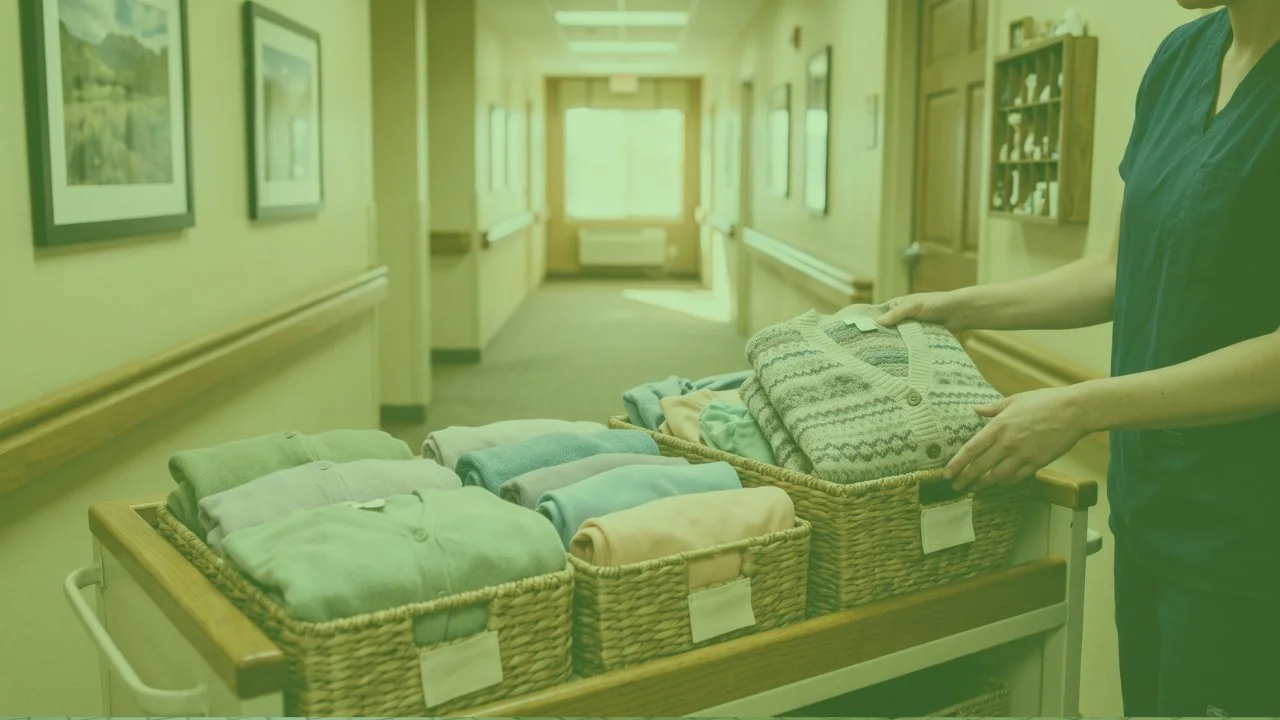
Personal clothing creates the hardest daily task: getting every item back to the right person. Both Colorado chapters address it, and Chapter 5 requires personal items to stay readily identifiable through processing and storage. Families notice quickly when that slips. Label every garment at move-in, then wash personal items in small loads by resident or by hallway. Smaller washers earn their place here, because they let staff run personal batches without half-empty large drums.
Resident skin deserves attention as well. Programmable cycles with automatic chemical injection deliver the same measured dose and full rinse on every load, which supports Colorado's residue and sensitivity requirements. Drying deserves equal weight. Milnor estimates that nursing homes that tumble-dry their sheets handle about 80% of their work as dry-fold items. For that reason, dryer capacity and folding space usually set the pace of the whole room.
Plan for the clothing, not just the pounds, and residents and families both notice the difference.
What Nursing Home Laundry Costs to Run in Colorado
Outsourced linen arrives as one invoice. In-house laundry spreads the cost across several lines, and a fair comparison needs all of them:
Installed cost: Machines plus delivery, plumbing, gas, venting, ventilation, and electrical work.
Water and sewer: Gallons per load times your rate, with sewer usually billed separately.
Gas and electricity: Drying dominates, so extraction speed moves this line most.
Labor: Staff minutes per load, including sorting, folding, and returning clothing.
Chemistry: Detergent and bleach priced per load and tuned to your temperature limits.
Service and parts: A maintenance plan, or an honest repair budget.
Outsourcing has a place, especially for small residences with little floor space. However, personal clothing is hard to send out, because every item has to come back to one specific resident. For that reason, communities often keep personal laundry in-house even when they outsource flat linen. Run the full comparison on both before you decide how to split the work.
Use the sizing math to make that comparison concrete. A 90-bed home planned at 6,300 pounds a week gives you a real volume to price against a linen service's per-pound rate, delivery charges, and monthly minimums. Then build your in-house cost per pound from the lines above, using your own utility bills rather than national averages. With both numbers on one page, the decision usually gets clear quickly.
Ventilation belongs in the budget from the start. Colorado's exhaust and positive-pressure rules for nursing homes can mean new ductwork, not just new machines. Retrofitting that later usually costs more than planning it now, so price the room, the machines, and the utilities together. Ask for ductwork, makeup air, and electrical work to appear as separate lines on the quote.
Finally, budget for uptime. A laundry outage in senior care means short linen carts and calls from families within a day. Real Clean Group backs installations with a 99% uptime guarantee and in-house service and maintenance. Measured against your current linen spend, total cost of ownership is the number that decides this.
5 Signs Your Community Has Outgrown Its Laundry Room
These signals come up again and again in the nursing homes and assisted living communities we assess across Colorado and Wyoming. Two or more usually means it is time to resize the room.
Families report missing clothing. Lost items usually trace back to a rushed sorting and return process, not careless staff.
Linen runs short before the weekend. A room that cannot rebuild par levels by Friday sits below real demand.
Clean and soiled carts share a path. Crossing traffic weakens infection control, and surveyors notice it.
Dryers run back to back all day. Long dry cycles point to low extraction, restricted venting, or an undersized dryer.
The census grew but the laundry room did not. New beds and memory care units add pounds the old room was never sized to carry.
None of these call for the biggest machines on the market. They call for a proper sizing before the next survey or family complaint forces a rushed decision.
Conclusion
Nursing home laundry equipment works when it fits the rules, the residents, and the real weekly volume. Start with the chapter that governs each wing, and build its requirements into the floor plan with a clean side, a soiled side, and one-way flow. Then size from pounds per bed per day and your actual weekly run hours, and adjust for memory care and personal clothing. Finally, plan service and parts support from day one. Done well, laundry becomes the quiet department that residents and families never have to think about.
Most laundry problems in senior care are not staff problems. They are layout, capacity, and timing problems, and each one has a practical fix. Real Clean Group handles equipment sales, service, parts, and renovation under one roof across Colorado and Wyoming, so the machines we recommend are the machines we then keep running. If your current machines are aging, our guide to repairing or replacing a commercial washer helps you decide what to keep.
Send us your bed count, care levels, current linen spend, and a floor plan if you have one. Request your free ROI report and we will size the room to your community, then show you plainly what in-house laundry will cost to run.